

This guide walks you through what you need, what you can defer, what most first-time owners overspend on as well as the estimated costs.
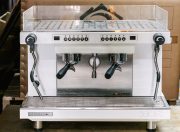
The biggest line item. Machines are described by group head count:
The rule of thumb most equipment techs use: a 2-group machine handles up to about 150 cups a day without sweat. Push it past 200 and the workflow gets tight. Above that, you want 3-group. Below 60 cups a day, you’re probably ok with a single group or entry level 2-group machine.
New 2-group commercial machines run $8,000 to $18,000. Refurbished, $5,000 to $11,000. New 3-group is $15,000 to $35,000 depending on brand. La Marzocco, Sanremo, Wega, Synesso. They all do the same job to varying degrees, lets unpack it further:
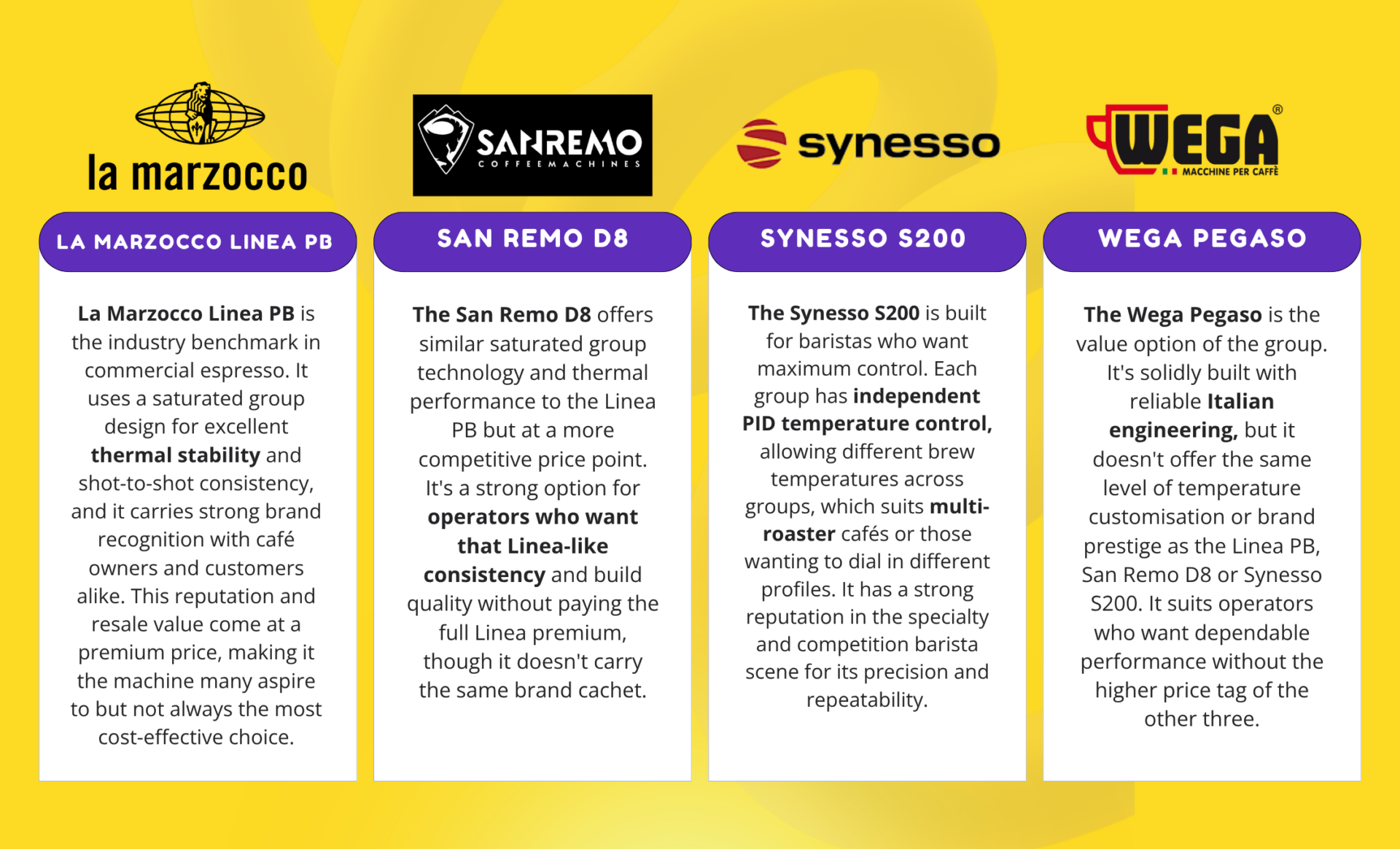
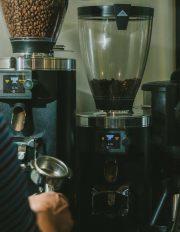
Where most first-timers underspend. Having the right grinder is make or break for serving a good cup of coffee. Much like the size of your coffee machine there could be a requirement for one, two or even three grinders on the bench. One, for a standard house blend, two for single origin or decaf and three if you do filter brew on top. $1,500 to $4,000 each for solid commercial grinders. The on-demand grinders with weight-based dosing run $3,000 to $7,000 and they’re worth it once you’re past 80 cups a day, because dose consistency is the potential efficiency meaning a wage cost reduction starts to come into play .
Nobody talks about this until the boiler scales up six months in and you’re staring down a $1,500 service bill. Carbon block plus scale reduction is the minimum. In hard water areas like much of Adelaide and parts of WA, full reverse osmosis with remineralisation. $300 to $1,500 to install. Cartridges $80 to $200, swap every three to six months. Skipping the water filter is the most expensive money you’ll save.
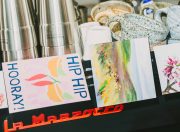
Knock box, tampers, distribution tools, milk jugs, bench scales, cleaning gear, tamping mats. $1,500 to $3,000 to kit out the bar properly. Don’t buy the $40 kitchen scale for dosing. Get a 0.1g jewellery scale or a proper coffee bench scale and your shot consistency will improve faster than any training program. That’s if you haven’t chosen the weigh based dosing grinder.
Most owners over-spec. A 3-group machine looks like growth, but if your bar is only three metres long and your barista hasn’t worked a 3-group before, the workflow around it is the real bottleneck, not the machine. You’ll burn $10,000 in extra capital cost and another $1,500 a year in water and power for a third group head that does nothing on a Monday morning.
Start at 2-group unless your business plan says 200+ cups a day from week one, with the staffing and bench layout to back it up. Upgrading to 3-group later is rarely the failure mode. Over-capitalising in week one is.
A serviced, descaled refurbished commercial machine from a reputable supplier will outlast many new second tier machines. The economics: refurbished is roughly 50 to 65% of new price, with parts-only warranty typically three months rather than 12 to 24 on new. If you have a reseller you trust selling the refurbished machine you’re looking for this could be the ideal route.
Buddy finances both. Most first-time owners take it refurbished on the espresso machine and new on the grinder, because the grinder is the part that gets the most daily abuse.
Talk to Jimmy at Buddy Capital. He’s spent years sitting across the table from first-time owners and can walk you through what a sensible kit looks like for your projected volume and bench layout.
Apply for an approval with us which only takes 15mins to submit!
Use the rental calculator to see what a roaster-funded “free” machine actually costs over 36 months.
