

This guide explains how “free” coffee machine deals really work, breaks down the hidden costs of supply contracts and helps you decide which option offers the best long-term value for your café.
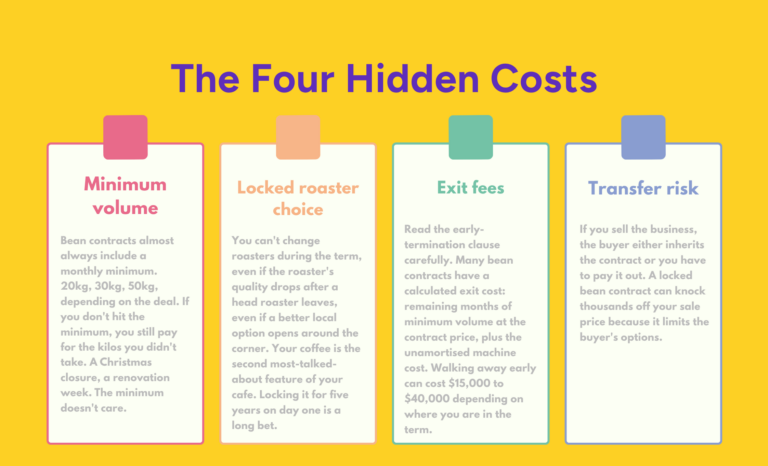
This is the most common trap first-time cafe owners walk into. A roaster offers a “free” or “loaned” espresso machine in exchange for a bean supply agreement. The maths looks great on day one. The lock-in only becomes visible three years in, when the coffee isn’t selling, the roaster has been bought out, or you want to switch to a blend your customers actually like.
A roaster (or in some cases, a coffee importer or distributor) buys or leases a commercial espresso machine. They install it in your cafe at no upfront cost. In exchange, you agree to buy your coffee from them. The agreement runs for a defined term, usually 2 to 5 years, with a minimum bean volume per month.
That last sentence is where the money lives.
The roaster has paid (let’s say) $15,000 for the machine. They need to recover that cost plus a margin over the agreement period. They recover it through the per-kilo price you pay for beans and through the volume commitment that locks you in.
Specialty wholesale coffee on an open contract typically sits in the $30 to $45 per kilo range in Australia, depending on the roaster, the origin, the relationship. Bean contracts that come bundled with a “free” machine commonly sit at $50 to $75 per kilo. Sometimes higher. The difference is the machine cost amortised across your beans.
Let’s run the numbers. Two scenarios, same cafe.
Cafe sells 60 cups a day, six days a week. That’s roughly 1,560 cups a month. At about 55 cups per kilo (double-shot espresso, no waste assumption), the cafe uses around 28kg of beans per month.
Scenario A: “free” machine, bean contract at $65/kg.
Scenario B: financed machine, open-market beans at $38/kg.
The two paths cost almost the same dollar amount over 36 months. The difference is what happens after.
At the end of Scenario A, you’ve spent $65,520, you don’t own the machine, and you’re at the bargaining table with a roaster who knows you’ve got nowhere else to go on day one of the renewal.
At the end of Scenario B, you’ve spent $63,252, you have full flexibility on roaster choice every quarter, and you have an end-of-term option to keep the machine (residual buy-out), hand it back, or upgrade.
Same money, different position.
Not every bean contract is a trap. Roaster-funded machines work in a few situations.
If you’re opening with very tight capital and you’re confident you’ll do consistent volume, a bean contract can be a legitimate way to get into the game. The volume commitment is only a problem if you don’t hit it.
If you have a strong existing relationship with a specific roaster (they’re your mentor, they trained your barista, they’re around the corner and you’re already buying their coffee at retail), the contract is just formalising what you’d do anyway. The lock-in is less risky because you weren’t going to switch.
If the roaster’s bean price on the contract is competitive (within 10 to 15% of open-market specialty pricing) and the term is short (12 to 24 months, not 5 years), the deal is fair.
A bean contract only turns into a trap when it’s priced as if you’d never run the numbers.
Eight questions to put to any roaster offering a machine deal. If the answers feel evasive, walk.
A roaster who is confident in their pricing and their service will answer all of these in writing. A roaster who hedges on any of them is showing you what the next five years will look like.
Buddy’s whole model is built around not having this conversation. You finance the machine through Buddy on a weekly rental. You buy your beans from any roaster you choose. You can switch if a better roaster opens nearby, if you outgrow yours, or if your roaster outgrows you.
The trade-off is honest: you’re paying for the machine directly, on weekly rental, rather than embedded in the bean price. The numbers usually work out close to neutral over a few years, but the optionality is yours, not the roaster’s.
Steve and Jimmy at Buddy will tell you when a bean contract is the right call for your situation. Sometimes it is. They’d rather lose a deal than put you in a contract that costs you the business in year three.
Our bean calculator lets you plug in your projected volume, the roaster’s offered per-kilo price, and the term length. It runs the maths against an equivalent financed machine on open-market beans, and shows you the dollar gap.
Use it before any roaster meeting. Even if you go with the bean contract, you’ll go in knowing what you’re paying for.
When you’re ready to look at financing the machine outright.