

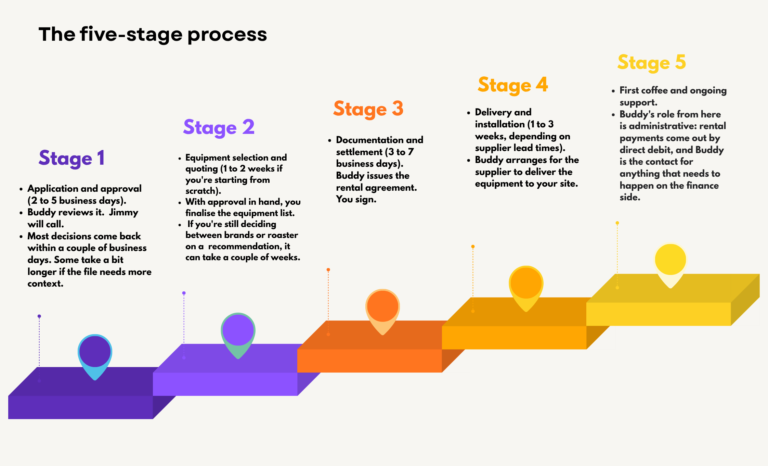
Stage 2: Equipment selection and quoting (1 to 2 weeks if you’re starting from scratch).
Stage 3: Documentation and settlement (3 to 7 business days).
Stage 4: Delivery and installation (1 to 3 weeks, depending on supplier lead times)
Stage 5: First coffee and ongoing support.
The bit first-time owners often miss: there are three parties in this process, and they each have a job.
You. Choose the equipment, choose the supplier, sign the docs, take delivery, schedule the install around your fitout, manage day-to-day operations once trading starts.
A Buddy will be in touch. Issues approval, manages the rental over the term, handles end-of-term options. Buddy is the financier.
Supplier. Delivers the equipment and install. Book them in advance, because commercial coffee install techs run lean and book out weeks ahead.
Once the equipment is running, the responsibilities split.
Buddy’s role. Buddy handles the rental: weekly direct debits, the rental agreement, end-of-term options, any restructure if your situation changes.
Supplier’s role. Warranty (12 to 24 months on new, 3 months parts-only on refurbished, depending on supplier), warranty repairs, parts. Some suppliers offer ongoing service contracts. Worth asking what’s included.
Your role. Daily cleaning, filter changes (water cartridges every 3 to 6 months, group head gaskets every 6 to 12 months, shower screens annually), descaling, paying for non-warranty service calls. The machine will need a full service every 12 to 18 months at minimum. Budget $400 to $1,200 per service depending on the gear.
Cafes that skip servicing don’t save money; they postpone the cost into bigger bills later. A boiler descale skipped for two years becomes a new boiler at year three.
Worth thinking about from day one, not from the last month. The rental agreement spells out your end-of-term options: return, upgrade, continue on a reduced rate, or buy out at residual. The residual figure is set at the start of the agreement, so you can plan the cash for it.
Most owners we see take the upgrade or continue option at end of term. A small but growing number take the buy-out. The return option is most common when the business has pivoted or closed.
Jimmy will reach out 60 to 90 days before end of term to walk through your options for that specific rentals so there’s no surprise.
Things move, a second site opens, the cafe pivots into a roastery, the first site closes. The rental can usually be restructured to fit, but the conversation needs to be early. Buddy can offer more options when there’s runway to work with.
If something’s changing in the business, call Jimmy.
