

This guide walks you through what rental, lease, and rent-to-own actually mean, what Buddy’s model looks like, and what to expect from approval through to end of term.
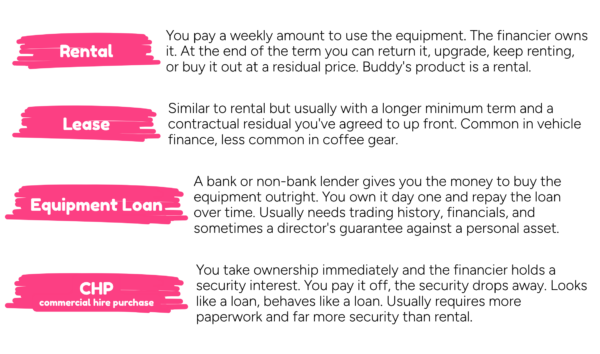
End-of-term options are spelled out before you sign. You can hand the equipment back, upgrade to a newer model, continue renting at a reduced rate, or buy it out at a residual figure.
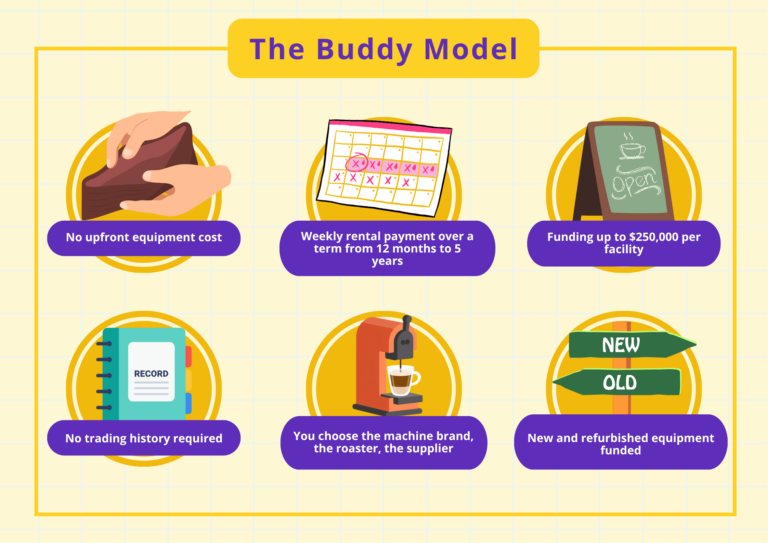
The weekly payment depends on the equipment value, the term length, and the residual structure. As a rough indicative range for a typical cafe equipment package of $20,000 to $35,000 over a 3-year term, weekly rentals tend to sit between $130 and $250 a week. Your actual number will move with the gear list, the term, and your application profile.
The big difference from a bank loan is what Buddy needs to make a decision.
You don’t need:
You do need:
Most applications get a decision within a couple of business days. Some take longer if the file needs more context. Once you’re approved, the funds go to the supplier (not to you) and the supplier delivers the equipment.
The end-of-term options are where rental either works for you or against you. Read them in the contract before you sign. Generally you have four paths:
Return. Hand the equipment back, walk away. No further obligation. Useful if your business has pivoted (you went from cafe to roastery) and you no longer need that gear.
Upgrade. Roll into a new agreement on newer equipment. The old gear goes back, a new rental starts. Common for cafes that started on a 2-group and have grown into a 3-group.
Continue. Keep renting at a reduced rate. Equipment that’s been through its capital cycle is cheaper to rent month-to-month than fresh gear, because the financier has already recovered most of the cost.
Buy out. Pay the residual figure and own the equipment outright. The residual is set at the start of the agreement, not at the end, so there are no surprises.
The right choice depends on where your business is at the time. Most owners we see take the upgrade or continue option after the first term. The buy-out makes sense if the machine is still doing the job and you’d rather own it than rent it.
Rental payments are generally treated as an operating expense and may be deductible in the year they’re paid. CHP is treated differently for tax purposes. The right structure depends on your business setup, your income, your other deductions, and how your accountant runs your books.
Speak to your accountant before signing. They’ll tell you whether rental, CHP, or outright purchase looks best given the rest of your numbers. Most cafe owners we work with end up on rental for cash-flow reasons regardless of the tax answer.
The phrase gets used loosely. In practice, rent-to-own means: at the end of the rental, you have an option to acquire the equipment for a defined residual. The option isn’t automatic and it isn’t free, and you don’t accumulate ownership over the rental term the way you would on a mortgage.
If you want to own the gear at the end, plan for it. Budget the residual into your end-of-term cash position. Buddy can also provide options for $1 buy out at the end of your term, the weekly pricing will be slightly higher. If you want to upgrade instead, you don’t need to. That flexibility is what you’re paying for.
Three things to take from this:
The downside, in fairness: over a long enough horizon, rental costs more than outright purchase. You’re paying for flexibility and for the financier’s cost of capital. If you’ve got more cash than time, buying outright is fine. If you’ve got more time than cash (which describes most first-time owners), rental is the cleaner path.
The fastest way to find out is to get pre-approved. The pre-approval doesn’t commit you to anything. It gives you a credit decision and an indicative weekly payment, so you can plan the rest of the fitout knowing what the equipment line is going to cost each week.
Apply to be pre-approved below. Jimmy will be in touch within a business day to talk through the equipment list and the options.